
A Shared Account for Procedural & Epistemic Non-Instrumental Information-Seeking (Dissertation)

The figure shows information viewing choices in Experiment 2. The y-axis shows the number of information viewing for each rating bin and the x-axis indicates previously rated questions in terms of how curious participants were to know the answer (black) and how confident they were that they knew the answer (pink).
Key finding: questions that had intermediate levels of confidence were associated with higher viewing in the two-bandit task.
This project proposed a shared underlying mechanism for information seeking that drew heavily on the Exploration-Exploitation Tradeoff and Curiosity-Driven Learning.
Three experiments used a two-armed bandit task in which participants selected between two options to earn cumulative points for a monetary prize. After their selection, they were offered either procedural (counterfactual information about the unchosen) or epistemic (answers to trivia they previously rated in terms of confidence and curiosity) for a 5-second time cost. Each trial was randomized, making both information conditions non-instrumental.
Experiments 1 and 2 measured the number of information-viewing decisions, and Experiment 2 measured three ERP components while viewing non-instrumental information.
Results indicated that prior familiarity was a strong predictor of information viewing choices and signals, suggesting that the differences between procedural and epistemic information sampling represent a continuum of information type, rather than distinctive mechanism.
Task/No-Task: Why Something Is Better than Nothing
(In Preparation)

Presenting at Purdue's Spring 2026 Cognitive Colloquium. Presentation shows logic behind adaptive algorithm (E3) in which the number of trials (task option) and the amount of time (No-task option) were adjusted based on participants choices.
This project investigated cognitive-effort based decision-making and the Need for Engagement framework (Agrawal et al., 2022) by offering participants a task and a no-task option.
Experiment 1 used three cognitive demand levels across three cognitive tasks (memory, motor, and hybrid). Participants in all nine groups preferred the task option, even when performing the task resulted in low accuracy.
Experiments 2 and 3 used adaptive algorithms to manipulate the number of trials and no-task timing depending on participants' preferences and decisions. Results indicated that task and no-task manipulations influenced how participants decided between the options, with participants indicating more willingness to perform the task option.
These results indicated that people experience a baseline need to engage and are willing to exert effort when the alternative is doing nothing. Further, the manipulations revealed that motivation is influeced by both intrinsic and extrinsic factors, indicating that this need to engage is an interaction of the environment and personal drivers.
Goal-Oriented Exploration-Exploitation Tradeoff (GO-EET)
(In Preparation)
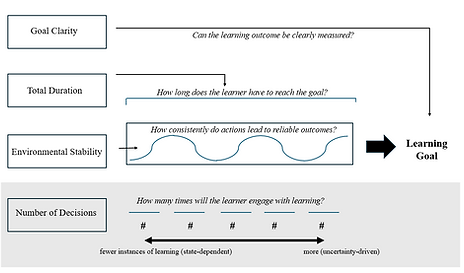
Figure shows the developing state of GO-EET. Factors such as goal clarity (i.e., how defined the goal state is), time constraints (total duration and number of decisions), and how stable the environment is between a current and goal state all interact to influence learning.
This developing framework examines how goal states influence the optimal learning strategy based on the exploration-exploitation tradeoff literature.
Rather than proposing a singular way of learning, this framework considers how the depth of the goal (e.g., level of desired expertise), time constraints (number of learning instances between a current a goal state and total duration of time) work together to influence how exploration show be externally scaffold to reach the desired goal state.
This framework draws heavily on expertise research, empirical evidence on self-directed learning, and previous exploration-exploitation tradeoff frameworks.